How ProTankr Works
Every truck-and-trailer combination has its own tare weight. Every trailer has its own compartment count and capacities. Every product has its own API range and density behavior, shaped by the terminal, the additives, the blend. Every driver has their own read on the road, the terrain, the delivery.
The variables stack up fast. So the industry found the simplest fix: pick a safe, memorable volume, well under the legal limit, and load that same number every time, no matter what actually changed.
It works, until it doesn't. A temporary shift causes an overweight ticket, and the response is to drop the volume again, permanently. The event that caused it passes. The lower volume never does.
This looks complicated. It isn't, not anymore. ProTankr handles all of it behind the scenes, so the driver stays focused on the road. In fact, we've stripped the input down so far that most days, opening the app is the only step: your load plan is already updated and waiting. When something does need adjusting, it's a few seconds, not a few minutes.
So while what the driver sees is simple, here's exactly what ProTankr is doing underneath.
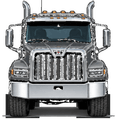
ProTankr also doubles as a place to store and share equipment details, a real digital transfer of knowledge (TOK) for your fleet. None of that is required to use the Planner, though; setup stays quick and simple.
Name the equipment (Unit #), add your compartments and their max volumes, and set your safety cap. Couple trucks to trailers freely.
Tare weight is the detail that matters most. Every coupled unit needs one. We recommend weighing the combined truck and trailer empty but with full saddle tanks, since it normalizes the math and builds in a burn buffer for the diesel used between the terminal and the scale.
Everything is tied to the equipment, not the driver, so it survives trailer swaps and shift changes without a reweigh or a lost detail.
After that, loading a truck is three taps: pick your terminal, tap a saved plan, hit Load. Everything else runs silently in the background.

Product temperature is one of the biggest hidden variables in a load, colder product is denser, so the same gallon count weighs more. Guess wrong and you're either leaving gallons on the table out of caution, or finding out you're overweight at the scale.
ProTankr predicts product temperature from real weather data and the physics of a large storage tank, then keeps correcting itself against what actually happened at each terminal, while always leaving the final call to you.

The only defense against an overweight ticket has been to either load on an axle scale or load conservatively, because doing the real density and thermal-expansion math by hand, for every load, at every terminal, isn't realistic on a schedule measured in minutes.
ProTankr runs the actual ASTM D1250 calculation automatically, the same standard terminals and weight enforcement use, so you can load to your real legal capacity instead of a safety margin built on guesswork.

Every driver is fighting the same invisible enemy: a new shipment or a tank change with a different product weight and/or density reading. Everyone pays for that uncertainty at the scale without any means to communicate the change with each other. As a consequence, many drivers get many overweight tickets before ultimately resolving to load light, all the time, just to cover the worst case.
ProTankr turns that around. The first driver to observe a shift corrects it for every driver who loads there next, across every company, in real time, instead of everyone independently re-discovering the same surprise.

Even with real time corrections from the self-correcting network, an occasional overweight reading still happens. API drift and temperature are the two real causes, and both are explainable, not random.
Here's why each one happens, and exactly what to do if your load report shows you over the legal limit.